Get in touch
Download Brochure
Download Guide
Get in touch
NASHVILLE HAS LANDED

Introducing Cam on Third
Invest in one of America’s fastest-growing cities, with studios, 1 & 2-bedroom apartments from $299,950.


The Knowledge Quarter Effect: How Liverpool’s Science Cluster Is Rewriting Tenant Demand


In this article
The Knowledge Quarter Effect: How Liverpool’s Science Cluster Is Rewriting Tenant Demand What the Knowledge Quarter actually is What has actually happened in 2026 Why this changes who the tenant is The supply side has not caught up Abbey Row: our Knowledge Quarter scheme Still to come- Average private rent in Liverpool reached £919 a month in October 2026, up 5.2% on the year against 3.8% across the UK, according to the ONS.
- Liverpool house prices rose 5.3% in the year to September 2026, to £189,000, at a time when English prices rose 0.8% and London prices fell.
- Knowledge Quarter Liverpool marks its tenth year in 2026. The 450-acre innovation district is the reason a growing share of that rental demand comes from salaried researchers and clinicians rather than students.
- Residential supply inside the district has not kept pace with the jobs, which is the opening for investors. Our own scheme there, Abbey Row, starts at £179,950.
The gap between rents and prices
Most cities this year are posting rent growth that outpaces price growth. Liverpool is doing something less common. It is running ahead of the national market on both.
The ONS puts average private rent in the city at £919 in October 2026, up from £873 a year earlier, a rise of 5.2%. The UK average rose 3.8% over the same period, to £1,411. On the sales side, the average Liverpool house price was £189,000 in September 2026, up 5.3% in twelve months, against 0.8% for England as a whole.
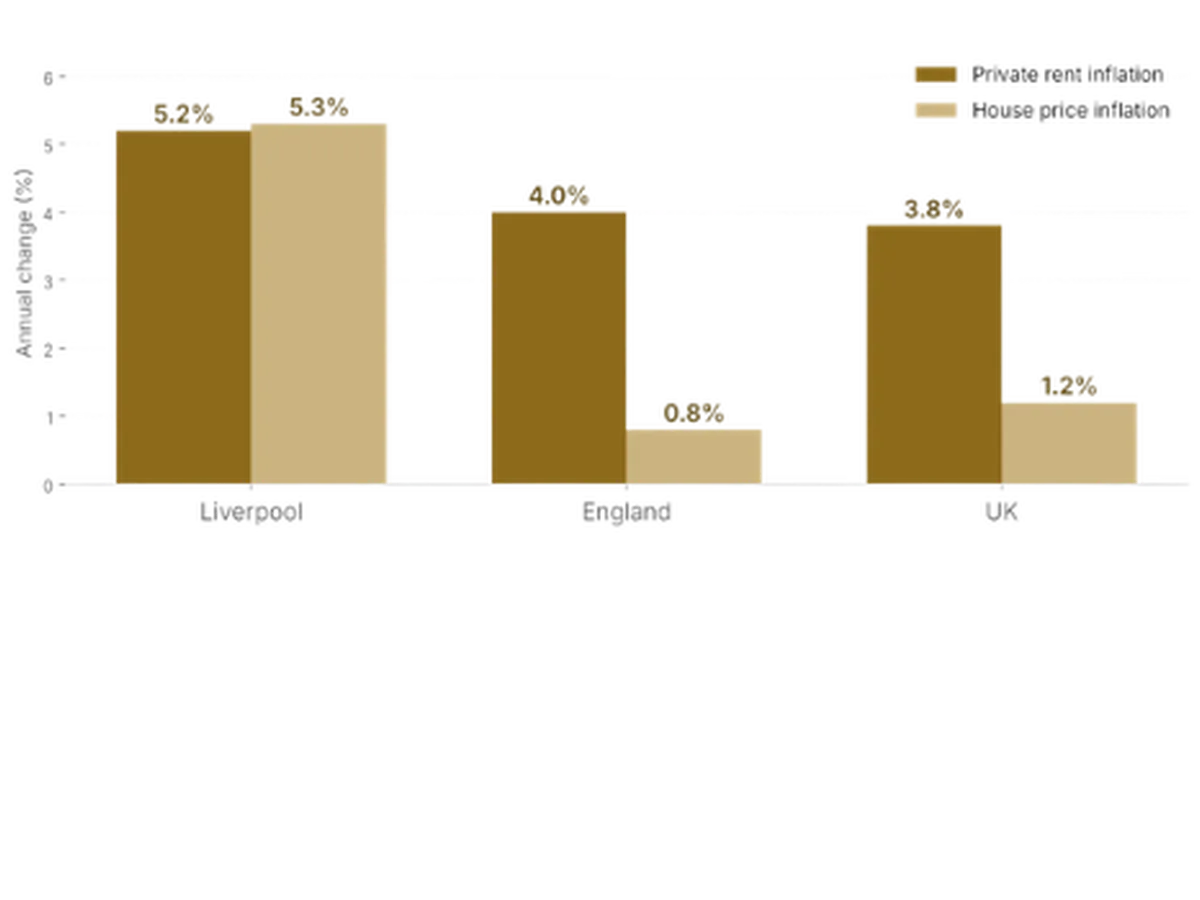
Source: ONS Price Index of Private Rents and UK House Price Index, November 2026 release. Rent figures cover the 12 months to October 2026, house price figures the 12 months to September 2026.
A city can post numbers like that for a while on affordability alone. Sustaining them needs employment, and that is where the Knowledge Quarter comes in.
What the Knowledge Quarter actually is
The Knowledge Quarter is a 450-acre innovation district on the eastern side of Liverpool city centre, and the organisation that promotes it, KQ Liverpool, is marking its tenth anniversary this year. It was set up in 2016 as a partnership between Liverpool City Council, the University of Liverpool, Liverpool John Moores University, the Liverpool School of Tropical Medicine and the city’s main NHS teaching trust. Our Knowledge Quarter investment page sets out the district in full.
At its eastern edge sits Paddington Village, Liverpool City Council’s £1bn flagship site. The 30-acre plot is earmarked for up to two million square feet of science, technology, education, health and residential space. The Spine, a 100,000 sq ft office building that houses the Royal College of Physicians’ northern home, and a Novotel are already open, alongside a multi-storey car park with an energy centre serving the whole site.
The scale is what makes it work as a rental catchment. The district holds more than 400 businesses employing over 15,000 people, alongside the Royal Liverpool University Hospital, the Clatterbridge Cancer Centre and the Liverpool School of Tropical Medicine, founded in 1898 as the first of its kind in the world. Around 62,000 students are enrolled across the city’s three universities, on the most recent HESA figures for 2024/25, with the two largest campuses sitting inside or beside the district.
What has actually happened in 2026
This year has been an unusually busy one for deliveries. In September, a UK-first £20m high-security robotic laboratory opened in the district for automated organoid research, work aimed at reducing animal testing. In April, LJMU launched a new artificial intelligence research institute. In July, a new Maggie’s cancer support centre broke ground inside the district, backed by £5m from the Steve Morgan Foundation.
The larger commercial schemes are advancing alongside them. Sciontec, KQ Liverpool’s development company, unveiled a redesigned HEMISPHERE laboratory and office scheme in March, now due to complete in 2028. Liverpool City Council and the University of Liverpool opened public consultation on Paddington South, the second phase of the masterplan, covering around 538,000 sq ft. Together, HEMISPHERE One and Two will add more than 216,000 sq ft of laboratory and workspace. In September, Liverpool was named a finalist for the World Intellectual Property Organization’s inaugural City of Innovation award, one of 15 cities worldwide.
Why this changes who the tenant is
Liverpool has always had rental demand. What the cluster changes is its composition, and composition is what determines how a tenancy behaves.
A student tenancy runs to an academic calendar, turns over every twelve months and concentrates every letting decision into a few weeks in late summer. A research technician, a postdoctoral scientist, a trial coordinator or a hospital clinician is on a salary and a contract that has nothing to do with September. They sign when the job starts, they stay while the project runs, and they can support a one or two-bedroom apartment rather than a room in a shared house.
That matters more in Liverpool than in most cities, because retention of its own graduates has historically been modest. Centre for Cities measured Liverpool at 31% of its university leavers staying on to work in the city, against 51% in Manchester. A cluster of salaried research and clinical jobs is precisely the mechanism that moves a number like that, and it also pulls in people who studied elsewhere.
For a landlord, the practical effect is a demand stream that is spread across the year, less exposed to the fortunes of any single university intake, and attached to employers who are not going anywhere quickly: a hospital, a medical school, a university research institute.
The supply side has not caught up
The Knowledge Quarter has been built out as a commercial and institutional district. Laboratory, office, hospital and teaching space has been delivered quickly, while new homes inside its boundaries have lagged a long way behind the employment they serve. Liverpool City Council is in discussion over roughly 300 apartments at Paddington Village, and even delivered in full that would meet a fraction of the demand from the people already working and studying there.
For an investor, that imbalance is the opportunity. Demand is institutional, year-round and growing, while the stock available to house it is thin and slow to arrive. Rents are rising from a low base and entry prices remain well below equivalent city centre product in Manchester or Leeds.
Abbey Row: our Knowledge Quarter scheme
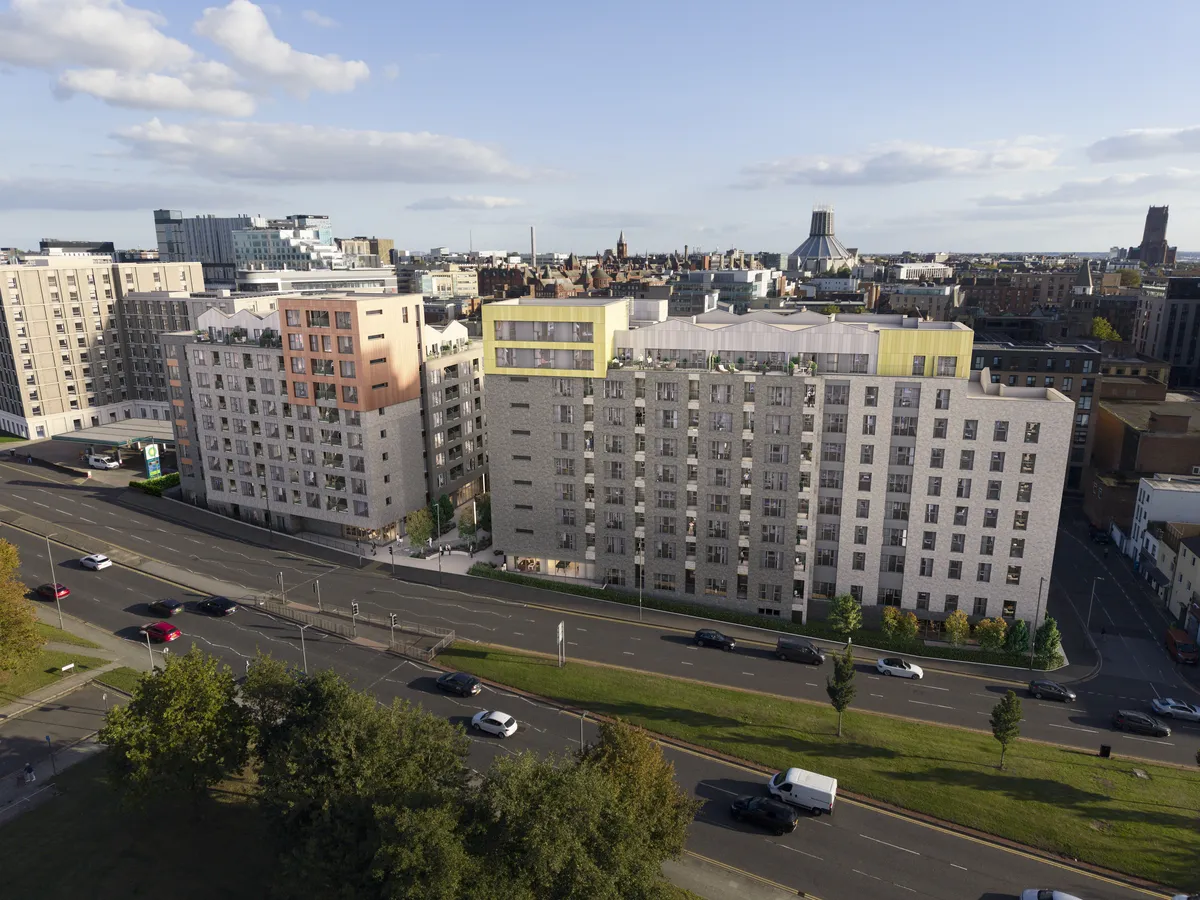
The practical question is proximity, because walkability to the hospitals, campuses and labs is what separates a Knowledge Quarter asset from a Liverpool asset. Abbey Row sits in the heart of the district, a 365-apartment development of studios, one and two-bedroom homes, with prices starting at £179,950 and a reservation deposit of £17,950.
It is approved for short-term lets, which matters in a district that draws visiting academics, clinical staff on rotation and families attending the hospitals as well as conventional long-term tenants, and our projections put returns at up to 12%. Residents get a specification built for that market, including a concierge, cinema room, gym, rooftop terraces and landscaped communal space, with retail at ground level.
At £179,950, Abbey Row offers an accessible entry point into the district. Full details, floor plans and current availability are on the Abbey Row development page.
Still to come
The most exciting part of this story is still ahead. HEMISPHERE completes in 2028, Paddington South is moving through consultation, and the Innovation Zone is a ten-year programme with job targets that will build year on year. Each milestone adds to the demand already flowing into the district.
That makes the timing interesting for investors. Rents in Liverpool are already rising faster than the national average, so the numbers stack up today. The cluster’s growth is the upside still to come.
Where this leaves investors
Liverpool is growing rents faster than the UK average and prices faster than England as a whole, and inside the city the Knowledge Quarter is where that demand is anchored to employers who are not going anywhere: a teaching hospital, two large universities, a medical school and a widening cluster of research businesses.
Our Knowledge Quarter page covers the district in detail, and our Liverpool investment page sets out the wider city picture including current developments, pricing and payment terms. If you would like to walk through how Abbey Row compares with other parts of the city on yield, tenant profile and exit, get in touch and we will run the numbers on your own basis.
This article is intended for informational purposes only and does not constitute financial advice. Property investment carries risk, including the risk of losing capital. Projected returns are estimates and are not guaranteed. Market data is accurate as at 19 November 2026. Independent financial advice should be sought before making any investment decision.
Similar posts you may like